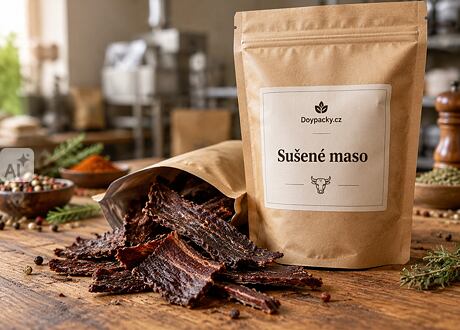
From a packaging perspective, dried meat is a completely different ballgame than, say, dried fruit. While a moisture barrier is crucial for fruit, the main enemies for meat are **oxygen and fat**. Jerky, biltong, and dried sausages contain 5–25% fat, which oxidizes, becomes rancid, and spoils the product’s taste and aroma within a few weeks—regardless of how well the packaging is sealed against moisture.
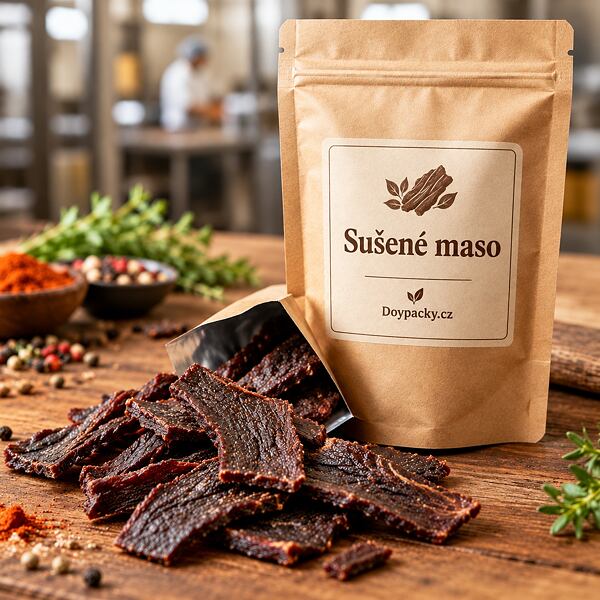
What Makes Dried Meat Unique
| Parameter | Typical value | Implications for packaging |
|---|---|---|
| Residual moisture | 20–25% (jerky), 10–15% (biltong) | Must not dry out or become damp |
| Water activity | 0.75–0.85 | Risk of mold growth if moisture increases |
| Fat content | 5–25% | Oxidation and rancidity, greasiness in the weld |
| Bulk density | 0.30–0.50 g/ml | Irregular slices, high air content |
| Shape | Sharp edges, rigid slices | Risk of puncturing the packaging |
1. The oxygen barrier determines shelf life
Unsaturated fatty acids react with oxygen even at very low concentrations. This results in a rancid taste, browning, and loss of aroma. Therefore, the key packaging parameter is **OTR**—oxygen transmission rate.
| Material | WVTR (g/m²/24 h) | Actual service life |
|---|---|---|
| Aluminum layer (PET/AL/PE, KRAFT/AL/CPP) |
< 0.1 | 12–18 months |
| Metallized PET (OPP/metPET/PE) | 0.3–1.0 | 6–12 months |
| PE + EVOH (recyclable) | 1–3 | 6–12 months, complies with PPWR |
| Kraft with window, transparent PET/PE | 3–10 | For short-term storage and quick consumption only |
**Recommendation:** A transparent bag without a barrier is suitable for dried meat only for fast-moving, on-site sales. For shelf sales with a shelf life of more than half a year, choose aluminum, metPET, or EVOH.
2. Light Accelerates Rancidity
Photooxidation of fats occurs several times faster than oxidation in the dark. At the same time, light converts red myoglobin into gray-brown metmyoglobin—the meat looks old, even though it’s safe. Therefore, the same rule applies to dried meat as to fruit: opaque packaging is an advantage, not a disadvantage. If you need to display the product, use recyclable EVOH bags with a window or place a photo of the product on the label.
3. Oxygen Absorbers and Packaging
- Oxygen absorbers—work exceptionally well with dried meat. They reduce residual oxygen to below 0.1% and significantly extend shelf life.
- Nitrogen flushing (MAP)—is suitable for production line packaging; for small batches, an oxygen absorber is often more practical and cost-effective.
- Vacuum—is effective, but sharp slices can puncture the film, causing the product to deform. It is not typically used for premium brands.
- Combination of an oxygen absorber and high-quality packaging barrier—this is the standard for export packaging.
4. Choosing the Bag Size
Dried meat is packed in irregular slices, leaving a lot of air between them. The actual volume is usually two to three times greater than what would correspond to the density of the meat itself.
| Net Weight | Product volume | Recommended bag volume |
|---|---|---|
| 25–50 g | 50–165 ml | 250 ml |
| 100 g | 200–350 ml | 500 ml |
| 200 g | 400–700 ml | 1,000 ml |
| 500 g | 1,000–1,800 ml | 2,000 ml |
**Allow for some extra space** if you're inserting an oxygen absorber. The extra space above the filling will also allow you to close the zipper easily and ensure a clean seal.
5. Grease in the weld — the most common cause of complaints
Fat migrates from the meat to the film and acts as a separator at the seal. The seal then looks intact but isn’t airtight—and you won’t discover the defect until after several weeks of storage.
- Leave enough space above the zipper for the seal; for fattier products, leave even more.
- Fill through the funnel so that the product does not touch the top of the bag.
- Seal temperature:** PE layer typically 140–160 °C, PP 160–180 °C; aluminum laminates require a longer heating time due to heat dissipation through the aluminum (200–250 °C).
- Check the seal quality—on every twentieth piece.
Summary
- For dried meat, the oxygen barrier is key, not the moisture barrier—the fat goes rancid before the product becomes moist.
- Opaque packaging protects both color and fat; choose a small window, or none at all.
- Oxygen absorbers work very well due to higher water activity; add them to every package.
- Allow for a volume 2–3 times greater than the weight of the contents.
- Ensure the sealing surface is clean when sealing the bag.